







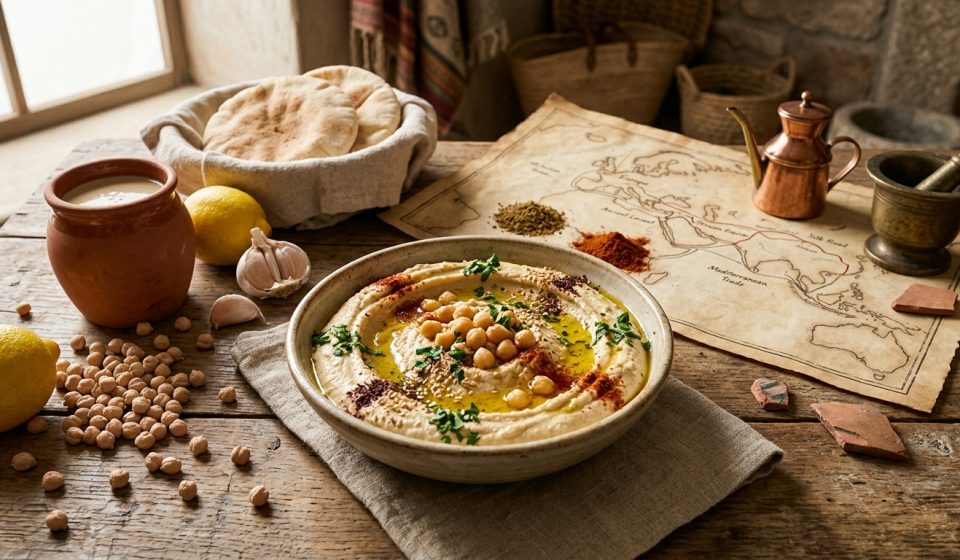

From a classic dip in Cairo, to a quickly flourishing Street-food according Istanbul and Tel Aviv; the hummus history matches the unique journey of one of the most popular food across globe. The narrative encompasses centuries of Middle Eastern culinary customs as well as the high level of exchange between cultures and global food trends.
The path from there to our grocery-store aisles, however, is a gnarled mess of decades-long international squabbling.
Bedrock of the Ingredients—Ancient Origins
And to chart its world history one must first account for the hummus itself.
Chickpea: Chickpeas (Cicer arietinum) are of the Fertile Crescent origin and probably one of mankind’s oldest cultivated foods since more than 10,000 years in food gardens The Middle East and Eastern Mediterranean.
Tahini (Sesame Paste): With the first records on history dating back to ancient Mesopotamia, sesame quickly became a chief source of oils & paste across Egypt, Persia and other regions.
Although these ingredients were eaten separately for millennia. The mixture that made Hummus by Tahini. It is an identity in recently human history is precisely the paste of chickpeas mashed and roasted with tahini, lemon and garlic combined.
Hummus History: The Earliest Records and Egyptian Connection
Today, different countries claim the dish as their own. Yet food historians searching antiquity for its first recorded uses invariably find them in medieval Egypt.
14th-century medieval Egyptian cookbooks—most notably Kanz al-Fawa’id fi Tanwi’ al-Mawa’id (The Treasure Trove of Benefits and Variety at the Table)—arguably contain the earliest recorded written recipe for a cold pureed chickpea dish made with tahini, spices, and acid.
However, during the Mamluk Sultanate, cooks prepared the dish with vinegar or salt-pickled lemons instead of fresh lemon juice, and street vendors likely served it to lower-class people as a meal for the poor.
Over the centuries, people adapted and developed this recipe along specific trade routes that linked Egypt. And more broadly the Ottoman Empire—to the Levant (Lebanon, Syria, and Palestine, rather than Jordan).
With its rich, earthy flavor and luxurious smooth-and-creamy texture, hummus was an obvious choice for many diners. Fast forward almost 50 years to the backrooms of some contemporary restaurants where you might find one of those disputes taking place.
In the late 20th and early 21st centuries hummus moved from being a largely local staple food to a national identity symbol as well as a geopolitical weapon.
Claims on Hummus, Region-Wise:
Lebanon, Israel, Palestine and Syria and Egypt also claim their own version of Hummus1000 as part of national cultural heritage.
THE Hummus WOODS: The International War Reached a Boiling Level of Contention From 2007 to 2010 For example; Lebanese food makers attempted to register « hummus » (think: Champagne for France) as a Lebanese AOP (appellation d’origine protégée) back in 2008. This triggered a light-spirited but salty rival to the Guinness World Record Titleholders goliath plate of hummus – disputably since it has been asserted Lebanon in 2010 with an astounding: just finished one effective 10,000 kg (22.000 lb) dish at any point!
As we know, most culinary historians also argue that hummus is an everyday regional dish. The result of thousands of years of cultural cross-fertilization among neighboring peoples. Ancient Mediterranean — overland trade networks and not a unique national invention.
Unpacking Hummus History: From Middle Eastern Meze to a Global Food
For example, the internationally popular spread hummus took an unparalleled evolution in the last 30 years:
NAW: If So, What Can You Do? People developed PHM as the only health movement to meet modern human needs. Thanks to the growing, North American led health and wellness movement, Hummus (and all its nutrient-dense glory) quickly became a global phenomenon within the now highly lucrative umbrella of modern day so-called “superfoods.”
The 21st Century: Industrialization & Reinvention of Hummus World brands began producing massive amounts of hummus for grocery store aisles, and new flavor combinations (roasted red pepper, garlic or avocado hummuses) were invented which did not follow the traditional recipe and were tailored to Western tastebuds.
Then again maybe you, have heard of Just how many? Economic Impact: Today, the global hummus market is home to a share million-dollar industry as one of your most ever shared modern day world foods crossover phenomena.
The Legacy of Hummus
Hummus: as simple as they come, yet immense with finite endless possibilities of the big broad world. Tt remained a rare few foods that all surpass borders and build bridges between cultures both near (here) and afar (yes, even that from nowhere to everywhere last night anywhere).
Hummus History: Which Country Invented Hummus?
No single country owns it. While the earliest known references to written recipes date back to 14th century Cairo, Egypt. It has instead evolved into a common custom around much of Egypt and Levant and the Ottoman Empire.
Frequently Asked questions:
Hummus: Why this international battle for ownership?
Lebanon and Israel vying for once gross national pride—now a multi-billion-Dollar market to shatter cultural world records
Kidding you, what honestly does hummus even stand for anyways?
ḥummuṣ (حُمُّص) itself is Arabic for “chickpeas”. The complete classic name of the plate is Hummus bi Tahina (chickpeas with tahini).
Hummus domination: How hummus took over world?
Abroad, it exploded into life as one of the health-food leviathans. A superfood, vitamin-rich, marketed to early-adopter high-end shoppers through a rapidly growing trend for plant-based/vegan/gluten-free in the West.


Comments are closed.
[…] the hundreds of traditional Middle Eastern dishes and foods, one particular dish has deeper cultural ties than most: Talbina. A warming desk dish made with a barley flour, milk and honey. The most […]