
Spaghetti Carbonara: The Mysterious Origins of Rome’s Iconic Pasta
Spaghetti Carbonara became one of the most famous dishes in Italy, so creamy and comforting. It will give you a warm hug. But behind that deceptively simple culinary facade is a veritable food fight, with the two factions vying for primacy. How Roman cooks brought a dish that people might consider mythical, yet iconic for Rome, into reality? To compare the history of carbonara with old-school Italian classics is to concoct a heady mix of culinary folklore, wartime ingenuity and post-war chic.
Where Did Carbonara Come From?
When food historians talk about the invention of Carbonara, they point to one of two leading theories.
The Charcoal Burners Theory Behind Carbonara’s Name
According to legend, the dish itself can be traced back to the carbonari. Charcoal burners that labored for hours hauling wood in the northern Apennine hills north of Rome. Because that meant they had to have food that could stay fresh long enough for them to work those entire nights. Very light: cured pork (guanciale), hard Pecorino Romano cheese, eggs and black pepper. The same applies to the hefty pepper dust shower you see near the end. It was supposed to look like coal dust (carbone), hence the name of the dish.
The American Connection: How World War II May Have Shaped Carbonara
Perhaps the most well-documented of those theories takes place in post-Second World War Rome, circa 1944. Combined American Pantry staples with the traditional Roman style of pasta making. Food was scarce and US GIs brought military rations of powdered eggs, bacon. Here is how Italian cooks left over ingredients and moulded it to the particular recipe of Spaghetti Carbonara. Curiously, first reference carbonara actually was found in an American cookbook (1952). A couple of years before appear as La Cucina Italiana (1954) in Italy.
Carbonara alla Romana: The Golden Rules of Authentic Carbonara
Original recipes have used garlic or pancetta in various amounts. But today Roman purists believe a minimum of five ingredients —
Spaghetti (or Rigatoni)
Guanciale – (sultry bursts of dark and red meat weeping deep beads of velvety fat)
Egg Yolk (1 Whole Only for emulsification)
2 Pecorino Romano – (tasty and hard sheep milk cheese)
Freshly Ground Black Pepper
Carbonara is cream less, pea-less and more than anything, garlic less. A creamy, cheesy, egg-based sauce made by whisking boiling starchy pasta water slowly into beaten egg yolks and cheese over low heat.
Frequently Asked Questions (FAQ)
The word carbonara in Italian means: Carbon.
Carbonara, for example, gets its name from carbonaro, the Italian word for “charcoal burner” or “coalmonger.” The name presumably comes either from the woodchoppers described, or how thoroughly black pepper penetrates it to render it looking like burnt ground.
Heavy cream — The Italian version of carbonara never has heavy cream.
No its a mortal sin of italian cuisine dishes but not cooking with cream as i was thought. The richness comes from the egg and Pecorino emulsion (along with starchy pasta cooking water).
You are fine until October 2023.
Purists demand guanciale (cured pork cheek) — the bigýest flavor and an even bigger fat cap. If not, so-so alternative is pancetta (the Italian version of thick-cut unripened bacon), if you don’t have access to Guanaciale.
Now those who have not used coddled eggs or how not to scramble the eggs, this can be a problem.
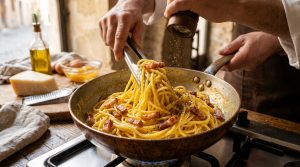
The skillet used for egg and cheese should never be over direct heat. Add quickly with a splash of reserved hot pasta water until silky and shiny (not so much that the eggs curdle).